Bridging the Divide: Why Enterprise AI Needs a Hybrid Low-Code/Full-Code Approach
The Two-Speed Trap in Enterprise AI
Every enterprise AI initiative eventually encounters a familiar bottleneck. On one side, business users embrace visual, low-code platforms that let them rapidly prototype dashboards, automate workflows, and deploy simple models—all without writing a single line of code. On the other side, data scientists rely on full-code environments like Jupyter notebooks, Python scripts, and custom frameworks to build sophisticated, production-grade machine learning pipelines. The result? A fragmented workflow where speed on one end collides with depth on the other, leaving teams struggling to scale innovation.
.png)
The Core Conflict: Speed vs. Control
Why Low-Code Falls Short
Low-code tools excel at democratizing AI. They allow business analysts, marketers, and operations managers to create predictive models, generate insights, and automate decisions in days rather than weeks. However, when a use case demands custom algorithms—say, a proprietary recommendation engine or a complex computer vision model—the visual interface becomes a limitation. Moreover, low-code platforms often lack the robust version control, monitoring, and deployment pipelines required for enterprise-grade reliability. Business users can move quickly, but they cannot go deep.
The Notebook Problem
Data scientists, by contrast, enjoy complete flexibility with full-code environments. They can import any library, debug line by line, and experiment with cutting-edge architectures. Yet this freedom comes at a cost. Notebooks and scripts are notoriously difficult to share, audit, or extend beyond the individual developer. Work becomes siloed, reproducibility suffers, and production deployment requires re-engineering from scratch. As one CTO put it: “Our data scientists build amazing things, but those things often live only on their laptops.”
The Hybrid Answer: Combining Low-Code and Full-Code
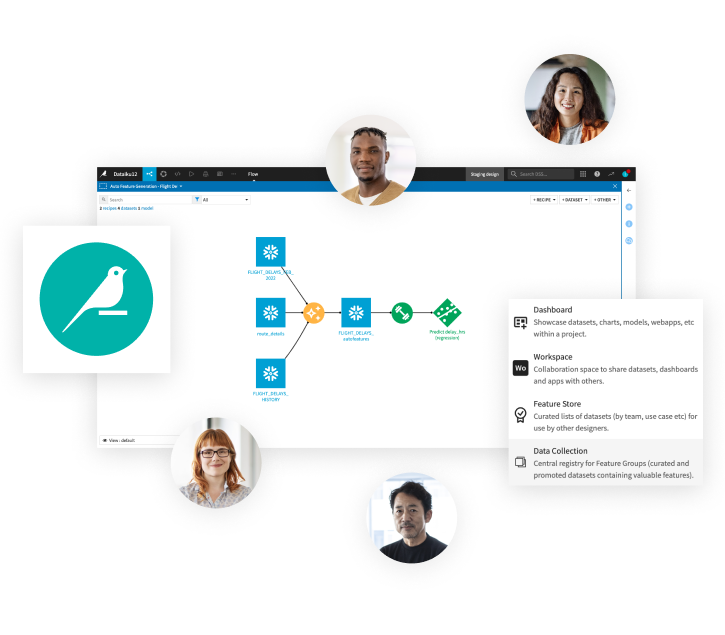
A growing number of enterprises are adopting a hybrid development model that bridges these two worlds. Rather than forcing teams to choose one approach, a hybrid platform integrates low-code visual interfaces with full-code extensibility. The goal is to let business users accelerate simple workflows while giving data scientists the ability to drop into code for complex tasks—all within a unified environment that supports collaboration, governance, and deployment.
Key Components of a Hybrid Platform
- Visual pipelines with code nodes: Users can drag-and-drop components for data ingestion, transformation, and model training, but also insert custom Python or R scripts when needed.
- Version-controlled repositories: Both low-code assets and full-code snippets are stored in a shared Git-backed system, enabling audit trails and rollbacks.
- Shared environments: Business users and data scientists can work on the same project, using the same data sources and infrastructure, without duplicated efforts.
- Production deployment wizards: One-click deployment for simple models, with options to customize for complex pipelines using containerization and orchestration tools.
Why Hybrid Outperforms Either Extreme
Faster Time-to-Value for Simple and Complex Use Cases
With a hybrid approach, a business analyst can prototype a churn prediction model in hours using drag-and-drop tools. If the model needs to incorporate a novel feature—like sentiment analysis from raw text—they can hand off the custom logic to a data scientist, who adds a code node in the same visual pipeline. The entire workflow remains intact, speeding up iteration cycles.
Improved Collaboration and Knowledge Sharing
The wall between business and technical teams crumbles when both groups can see and extend each other’s work. Data scientists can review the logic behind a visual model, while business users can understand and validate the code contributions. This transparency reduces misunderstandings and fosters a culture of shared ownership.
Better Governance and Compliance
Regulatory requirements demand visibility into how AI models are built and deployed. Hybrid platforms enforce consistent logging, access controls, and “code-as-configuration” principles, ensuring that even low-code actions are tracked. Auditors can inspect the full lineage from raw data to final prediction, regardless of whether it was created visually or programmatically.
Scalability Without Sacrificing Flexibility
As AI initiatives grow, hybrid platforms scale more smoothly than pure low-code or full-code solutions. Teams can standardize common patterns (e.g., data preprocessing, model evaluation) as reusable low-code blocks, while still allowing experts to branch into custom code for novel problems. This balance prevents technical debt from either oversimplification or over-engineering.
Implementing a Hybrid Strategy: Practical Steps
- Assess your team’s maturity: Map who does what today. Identify where low-code speed is most valuable and where full-code depth is non-negotiable.
- Choose a platform that supports extensibility: Look for tools that allow custom code injection, offer an SDK or API, and provide pre-built connectors for popular data sources.
- Define clear workflows for handoffs: Establish templates and guidelines for when a business user should request a code node, how data scientists should package custom logic, and how both sides will test the integrated pipeline.
- Invest in training and documentation: Teach business users enough Python to read and validate code nodes, and expose data scientists to visual pipeline design patterns so they can support rapid prototyping.
- Establish governance early: Set up version control, role-based access, and production review gates before the hybrid environment grows.
The Future of Enterprise AI Is Hybrid
The two-speed trap will only worsen as AI demands accelerate. Companies that force everyone onto low-code platforms risk hitting a ceiling on complexity; those that insist on full-code everywhere miss the agility that business users need. The hybrid model—where visual simplicity coexists with code flexibility—offers a pragmatic path forward. By combining low-code and full-code in a deliberate, well-governed way, enterprise AI teams can finally break through the wall and deliver innovation at both speed and scale.