4 Critical Innovations in Meta’s End-to-End Encrypted Backups
Meta has been steadily reinforcing the security of its messaging platforms, WhatsApp and Messenger, with end-to-end encrypted backups. These backups ensure that your message history remains private, even from Meta itself. The cornerstone of this system is the HSM-based Backup Key Vault, which stores recovery codes in tamper-resistant hardware. Recently, Meta introduced two significant upgrades: over-the-air fleet key distribution for Messenger and a commitment to transparent fleet deployment. Below, we break down the four essential elements of this evolving security architecture.
1. The HSM-Based Backup Key Vault: A Fortress for Recovery Codes
At the heart of Meta's encrypted backup system lies the HSM-based Backup Key Vault. This vault safeguards recovery codes—the keys that unlock your backed-up message history—within hardware security modules (HSMs). These HSMs are tamper-resistant, meaning not even Meta, cloud storage providers, or third parties can access the codes. The vault is deployed across multiple data centers worldwide, using a majority-consensus replication scheme to ensure high availability and resilience. By storing your recovery code in this distributed HSM fleet, Meta guarantees that only you—using your recovery code or passkey—can decrypt your backed-up messages. This foundational layer makes it impossible for Meta to read your data, even if compelled by legal requests.
2. Passkeys Simplify Encryption for Everyday Users
Late last year, Meta made it easier for users to enable end-to-end encryption for their backups with passkeys. Passkeys are FIDO2-based credentials that replace traditional passwords with biometric or device-based authentication (like fingerprints or Face ID). Instead of remembering a complex recovery code, users can now protect their backups using their device’s built-in security. This lowers the barrier for non-technical users to adopt strong encryption. When you set up a passkey, it is stored locally on your device and synced via your cloud account, but the cryptographic key used for backup encryption remains in the HSM vault—ensuring Meta never has access. This upgrade complements the existing recovery code system, giving users a more convenient option without compromising security.
3. Over-the-Air Fleet Key Distribution for Messenger
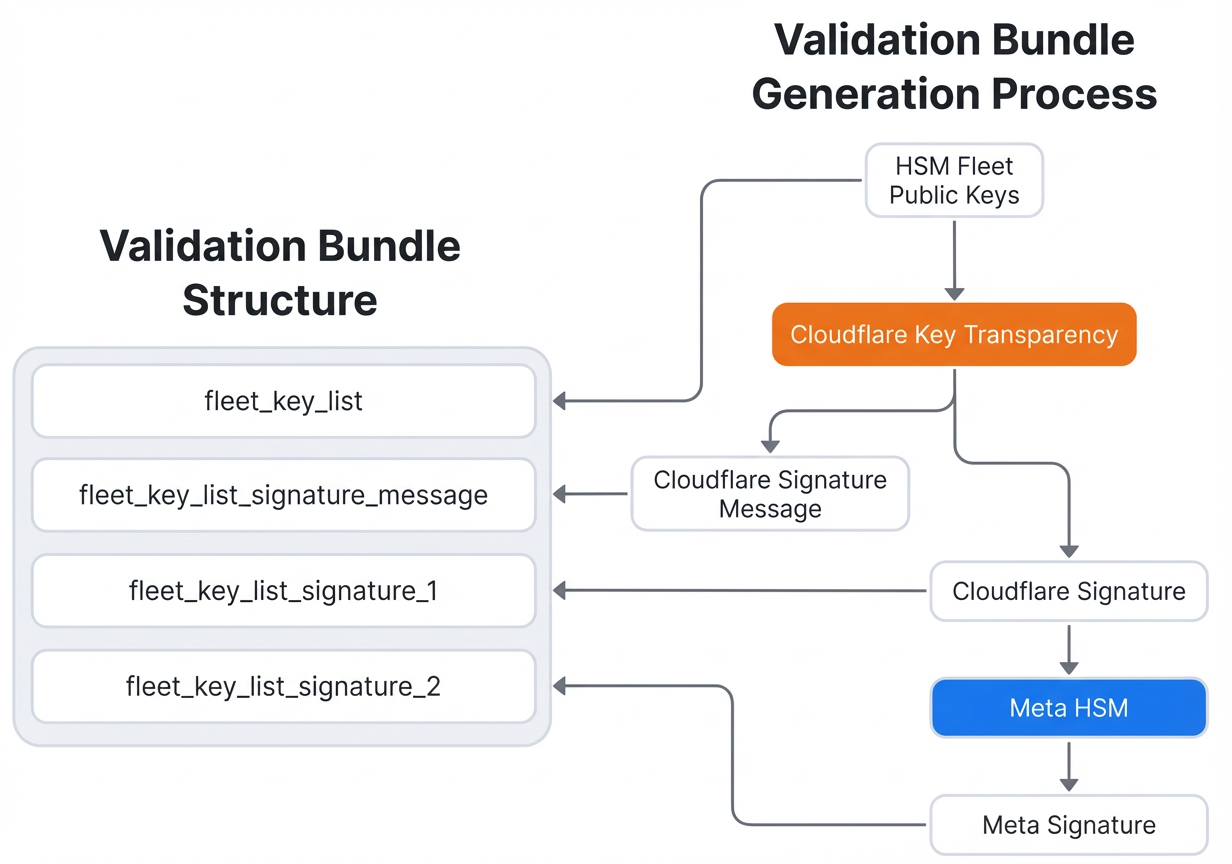
To extend encrypted backups to Messenger without requiring app updates, Meta developed an over-the-air mechanism for distributing fleet public keys. Previously, in WhatsApp, these keys were hardcoded into the app. For Messenger, when a new HSM fleet is deployed, the fleet’s public key is delivered to clients in a validation bundle. This bundle is signed by Cloudflare, an independent third party, and then counter-signed by Meta. This dual signing provides cryptographically verifiable proof that the key is legitimate and hasn’t been tampered with. Cloudflare also maintains an immutable audit log of every bundle issued. Clients validate the signature chain before establishing a session, ensuring they only communicate with authentic HSMs. This approach allows Meta to dynamically scale its HSM infrastructure for Messenger while preserving end-to-end security.
4. Transparent Fleet Deployment: Proof That Meta Can’t Access Your Data
Meta is now publicly committing to transparency in its HSM fleet deployments. To demonstrate that the system operates as designed—and that no one can retrieve users’ encrypted backups—Meta will publish evidence of each new fleet deployment on its engineering blog. New HSM fleets are deployed infrequently, usually every few years. When a new fleet goes live, Meta will release cryptographic evidence that the deployment adhered to its security blueprint. Users and security researchers can verify this evidence by following the audit steps outlined in Meta’s whitepaper. This transparency initiative is part of Meta’s broader effort to lead the industry in secure encrypted backups, giving users independent assurance that their message history remains private—even from the company that built the system.
Meta’s encrypted backup system is already among the most robust available, and these two latest updates—over-the-air key distribution and transparent deployment—further strengthen its trustworthiness. By combining a tamper-resistant HSM vault, user-friendly passkeys, and verifiable security evidence, Meta empowers users to protect their conversations without relying on blind faith. For the full technical details, including cryptographic protocols and audit instructions, read the official whitepaper: Security of End-To-End Encrypted Backups.